
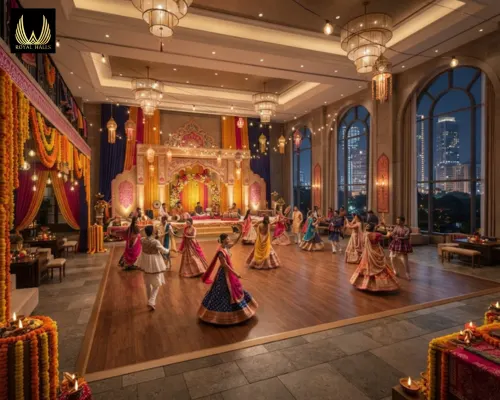
Navratri is nine nights of activity, and in Mumbai that usually means more than one event. There is the aarti and the pooja, then the garba and dandiya nights that continue well past midnight, then a family lunch or dinner to close it out. Some families also host a corporate Navratri function during the same period.
Each of these needs something slightly different from a venue, and most families discover the difference only when their hall turns out to be wrong for one of the functions. If you are searching for Navratri event venues in Mumbai, this guide covers the formats, the practical requirements and what to ask before booking.
Navratri celebrations in Mumbai generally fall into three categories, and they have very different spatial needs.
Corporate Navratri functions add a fourth variant, which we cover separately below.
Garba nights are the reason many families search for a large hall in the first place. A garba circle, or a chaal, needs a big uninterrupted floor area, and by the second half of the night the space is at its busiest. Guests change places constantly, and the hall needs to feel spacious enough that movement does not become uncomfortable.
Three things matter most.
Royal Halls' two pillarless multipurpose air-conditioned halls provide approximately 15,000 sq. ft. of space and can be combined for around 1,000 guests, which suits large garba nights comfortably.
Late-night garba functions create a specific catering challenge. Guests arrive over several hours, eat at unpredictable times, and often want something light rather than a full meal. Serving a heavy dinner in the middle of dancing tends to slow the evening down unnecessarily.
The usual approach is a mix: refreshments and light counters available through the evening, with a main service timed either early, before dancing builds, or late, towards the end. Street-style counters, chaat, snacks and a late chaat round tend to work better than a single formal dinner for this format.
Royal Halls provides catering, so the timing of the counters can be planned against the hall schedule rather than treated as a separate vendor's problem.
For the devotional function, the hall setup is different. You need a clean, dignified area for the idol and the aarti, with enough open space around it for the congregation, and a surface that can be decorated traditionally.
Useful details to check when visiting a venue:
Because the halls are pillarless and open-plan, different areas can be zoned for the pooja, seating and dining within the same space, which is useful when the same hall hosts a pooja in the morning and a garba night in the evening.
Many companies use the Navratri period for an internal celebration — a cultural evening, a garba gathering, a traditional lunch with performances, or a combination of a pooja followed by food and music.
A corporate version needs slightly different things from a family version.
Royal Halls offers AV systems, catering, décor and security in-house, which keeps a corporate festive function to a manageable number of coordination points. We have written about this in more detail in how to plan a festive corporate party that employees will remember.
Navratri décor is traditionally rich — marigold, red, orange and gold, with lighting and garlands. In a large air-conditioned hall, the trick is to concentrate the traditional elements at the points guests actually look at.
Royal Halls provides décor support, so the styling can be planned around the actual hall layout rather than after the event date. See previous setups in the Royal Halls gallery.
Garba nights end late, often after midnight, which changes the arrival and departure pattern significantly. Most guests arrive in the early evening, but the exit happens all at once.
Two things help more than anything else: a clear exit plan so the crowd does not funnel into a single bottleneck, and valet service so guests do not need to walk across a car park in the dark. Royal Halls offers parking for 300+ cars, valet service and on-site security, which is particularly relevant for late-night festive functions.
Because Navratri involves several functions across nine nights, it is worth asking whether a venue can hold consecutive dates. Hosting the pooja, one or two garba nights and the closing dinner at the same property removes repeated setup, reduces travel for guests and makes it far easier to run the celebration as a whole.
Royal Halls can host multiple events on consecutive dates, including devotional functions, garba nights, family dinners and corporate gatherings. If you are planning a longer festive-season schedule, see our guide to managing multiple functions in one venue.
Navratri dates fall early and the festive season books out quickly. Share your function dates, expected guest counts and whether you need a pooja setup, a garba floor or a corporate programme, and we will show you the hall arrangement that fits.
Royal Halls
1st Floor, C-Gate Nehru Entrance, National Sports Club of India, Lala Lajpatrai Marg, Lotus Colony, Worli, Mumbai, Maharashtra 400018
Phone: +91 90824 87592 / +91 93725 73680
Email: marketing@royalhalls.in
View Royal Halls on Google Maps or contact Royal Halls to discuss your Navratri functions.
Yes. The pillarless AC halls provide a large open floor for garba and dandiya, with AV support for music and announcements.
The two pillarless AC halls can be combined to accommodate around 1,000 guests, depending on the event layout and requirements.
Yes. The open-plan pillarless layout allows different areas of the hall to be zoned for the idol and seated pooja guests during the day and re-arranged for dancing in the evening.
Very. A packed hall dancing for several hours generates significant heat, so full air conditioning across the hall is essential for guest comfort.
Royal Halls is located at the National Sports Club of India, Lala Lajpatrai Marg, Lotus Colony, Worli, Mumbai, Maharashtra 400018.