
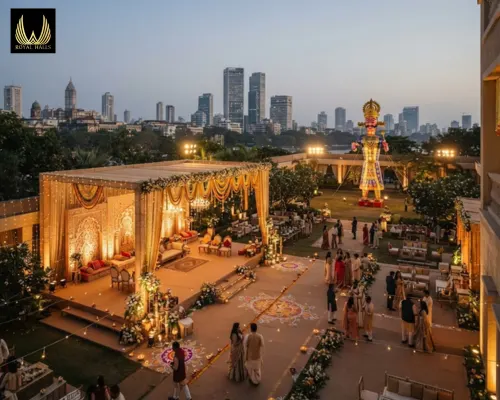
Dussehra is one of the most emotionally charged days of the Hindu calendar, and in Mumbai it is celebrated in a strikingly local way. The day brings the Ramlila, the burning of the Ravana effigies, families gathering for aarti, young people performing in the lead roles, and then a busy afternoon and evening of food and company.
What makes Dussehra different from most festival functions is the mixture. It is devotional, theatrical, social and very local all at once, and the venue has to support all four. If you are looking for Dussehra celebration venues in Mumbai, this guide covers what to plan for and what to ask.
A typical Mumbai Dussehra gathering, whether at a family or community level, involves a sequence of activities rather than a single event.
Each of these places a different demand on a hall, which is why a venue that works beautifully for a Diwali party may not be right for Dussehra.
A Ramleela needs a performance area that is visible from the seating and large enough for stage movement and props. This is the element most often overlooked when a family books a hall for Dussehra, because the focus tends to be on the effigy rather than the performance.
Useful questions to ask a venue before booking:
Royal Halls' halls are pillarless, which means the full width of the room is available for both the stage and the seating — useful for a performance where visibility matters more than intimacy.
The burning of the Ravana effigy is a fire activity, and it needs to be treated as a safety matter rather than a decorative one. Effigies are typically built on site over several days, which means the venue must be willing to allow early access.
The practical checklist:
Discussing this with the venue in advance — rather than on the morning of the event — is what keeps the day smooth for everyone.
Dussehra is a full-day affair, beginning in the morning with the pooja and continuing into the evening. That is a long time to be indoors, and the early part of the day can still be warm in Mumbai.
Full air conditioning across the hall is important for this reason. It is also why a large, open hall works better than a segmented one — guests move between areas throughout the day, and they should be able to do so comfortably. Royal Halls' two multipurpose air-conditioned halls provide approximately 15,000 sq. ft. of space and can be combined for around 1,000 guests.
Community and family Dussehra meals are served to a large group at a similar time, which is a real service challenge. A hall filled with 400 people who all want lunch at noon needs a plan.
Options that work well include serving in two staggered sittings, using multiple counters spread around the hall rather than one line, and combining a light prasad counter with a separate main-counter meal. Water and drink stations placed away from the main queue help more than almost anything else.
Royal Halls provides catering, so the service plan can be discussed against the actual hall layout before the day arrives.
Dussehra décor is often simpler than Diwali décor, and that is appropriate. The visual focus of the day is the effigy and the performance, not the hall. Traditional touches work well — marigold and floral decoration at the entrance, a decorated stage for the Ramleela, lighting around the seating, and rangoli or floor decoration near the pooja area.
It is worth keeping the main floor relatively clear. Guests sit on the floor during parts of a Dussehra gathering, and heavy décor in the centre of the hall is both inconvenient and quickly damaged. Royal Halls provides décor support, and you can see completed setups in the Royal Halls gallery.
Companies in Mumbai also mark Dussehra, often with a cultural programme, a pooja, a traditional lunch and an evening of music. This format is closer to a corporate festive function than a community Dussehra gathering.
The requirements are predictable: a clear view of the stage for the cultural performances, sound support for a host-led agenda, organised seating by department or family, and catering timed so it does not clash with the programme. Because employee groups arrive together and leave together, the exit plan and parking arrangement matter more than for a family event. We cover this format in how to plan a festive corporate party that employees will remember.
A Dussehra gathering is famously intergenerational. Young children perform, parents organise, and grandparents spend most of the day seated. The hall should therefore support all three without compromise.
These are available at Royal Halls along with parking for 300+ cars, valet service and on-site security. The complete list is on the facilities page.
Dussehra falls in the busiest season for Mumbai events, and halls in central locations fill up well ahead of the date. Share your expected guest count, whether you are planning a Ramleela performance, a community meal, a family gathering or a corporate function, and we will show you the hall setup that works.
Royal Halls
1st Floor, C-Gate Nehru Entrance, National Sports Club of India, Lala Lajpatrai Marg, Lotus Colony, Worli, Mumbai, Maharashtra 400018
Phone: +91 90824 87592 / +91 93725 73680
Email: marketing@royalhalls.in
View Royal Halls on Google Maps or contact Royal Halls to check availability.
Yes. The pillarless halls provide a clear stage and viewing area, with power and AV support available for performances.
This is arranged in advance with the venue, covering builders' early access, a controlled burning area kept away from guests and décor, and a clear route for the fire crew.
The two pillarless AC halls can be combined to accommodate around 1,000 guests, depending on the layout and requirements.
Yes. Catering is available in-house, and the service plan can be built around staggered sittings or multiple counters for a large group.
Royal Halls is located at the National Sports Club of India, Lala Lajpatrai Marg, Lotus Colony, Worli, Mumbai, Maharashtra 400018.